Marble types: a beginner's guide
Clay, china, aggies, swirls, onionskins, sulphides, Lutzes, cat's eyes, clearies and steelies, plus shooters and sizes. A plain guide to marble types.

Pick up a jar of old marbles and you will find dozens of different looks. Collectors have names for all of them, and the names can be confusing, because the same word means different things in different places. This guide covers the main types a beginner is likely to meet, grouped by what they are made of and how they were made.
Clay and china
Clay marbles
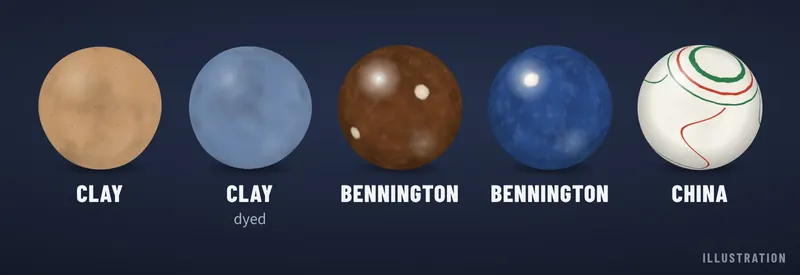
Clay marbles are the plain, slightly rough ones, often tan, sometimes dyed red, blue, green or yellow. The Marble Collectors Society of America calls them "the most common old marble that you will find" [2]. Wikipedia notes they were made in huge numbers in the 1800s and early 1900s, which is why they are sometimes called commies, short for "commons" [1].
A glazed version, usually brown or blue with small light "eyes" where marbles touched in the kiln, is known to collectors as a Bennington. The name is a misnomer: it appears that all of these marbles were imported from Germany [2].
China marbles
Chinas are made of glazed porcelain, often with painted lines or patterns [1].
Stone and steel
Aggies
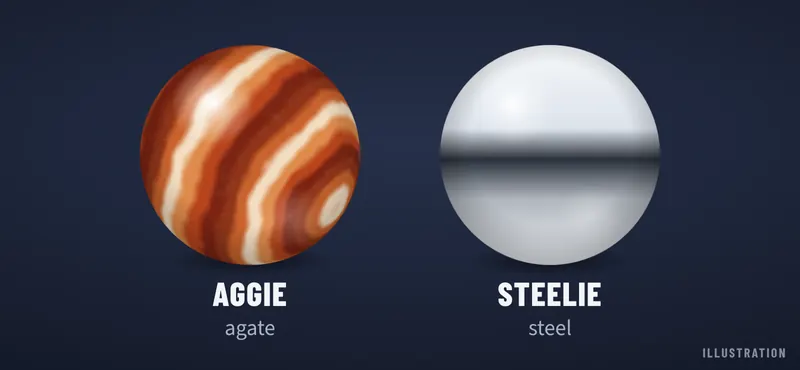
An aggie is a marble made of agate, or of glass made to look like agate [1]. Real stone marbles were ground into spheres, and German glassmakers took inspiration from the polished agate spheres of the gemstone town of Idar-Oberstein [10]. Britannica lists onyx and agate among the materials marbles have been made from [9]. Because people use "aggie" for both stone and glass, ask which one is meant.
Steelies
A steelie is a steel marble. Old ones were made from folded sheet steel, and later ones are solid ball bearings [1]. Steelies were often used as shooters [13], but tournaments ban them: in the US National Marbles Tournament, a shooter must be glass or stone, never metal [11].
Handmade German glass
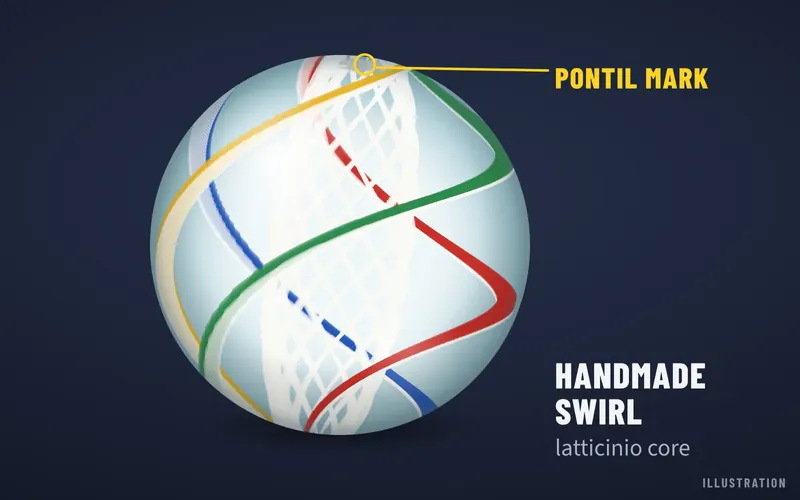
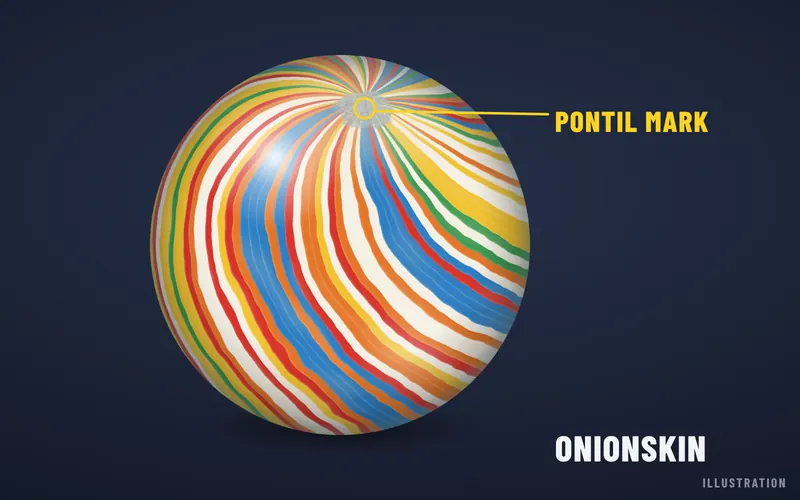
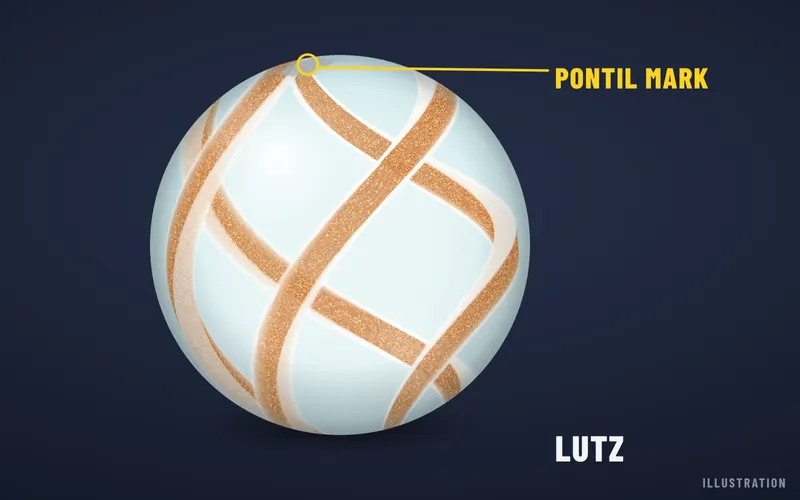
These are the marbles collectors prize most. Most were made in Germany between about 1850 and the Second World War, and every handmade marble has at least one small rough pontil mark where it was cut free [3].
Swirls
A swirl has bands or threads of color twisting from pole to pole. Handmade swirls get their twist from the way they were turned while being made [6]. Machine-made swirls exist too, and Wikipedia describes the common "swirly" as a glass marble with one swirly color [1].
Onionskins
An onionskin is a handmade swirl whose surface is covered with many closely packed streaks of color, a bit like the layers of an onion [1].
Lutzes
A Lutz has bands of glittering metallic flecks in the glass, made with finely ground copper flakes or goldstone. The bands are usually edged with thin white strands [4]. There are banded, onionskin, ribbon and other Lutz varieties [4]. The name is often linked to the glassmaker Nicholas Lutz, but he is wrongly credited with them [1].
Sulphides
A sulphide is a large clear glass marble with a small white figure inside, usually an animal, sometimes a person or a religious figure. The figure is porcelain, not sulfur. Early collectors simply assumed it was sulfur, and the name stuck. Sulphides were made in Lauscha, Germany, from the mid-1800s until 1936 [5].

Machine-made glass
From the early 1900s, machines took over toy marble making [3].
Clearies
A clearie is a plain transparent marble, clear or colored, with nothing inside [1][6]. It is sometimes called a crystal or a purie [1].
Cat's eyes
A cat's eye is a clear marble with colored vanes inside, like the pupil of a cat's eye [1][7]. By the 1950s they were common. The Marble Collectors Society of America says they became the main marble after the Second World War, made in East Asia and in the US [6]. Marble King's Roger Howdyshell is credited with the first American-made cat's eyes [7], but who made the very first one is disputed.

Other names you will see
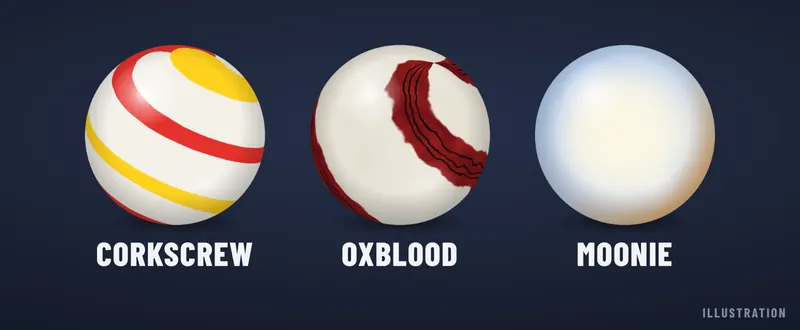
Machine-made marbles come in many patterns, and makers gave them their own names. A few examples from Akro Agate of West Virginia, which made marbles from 1910 to 1951 [8]:
- Corkscrews: two or more spirals of color winding from pole to pole.
- Oxbloods: a deep red patch or swirl with fine black threads in it.
- Moonies: milky white opalescent glass.
Shooters and taws
The shooter, or taw, is the marble you shoot with, usually a little bigger than the others [1]. In Britain it is often called a tolley [12]. Kids have plenty of other names for it. A survey by the Dictionary of American Regional English collected "shooter", "steelie", "boulder" and "aggie", among others [13].
Tournaments set limits:
- US National Marbles Tournament: shooter between 1/2 and 3/4 inch across, glass or stone only [11].
- British and World Marbles Championship: a tolley up to 3/4 inch across, glass or ceramic [12].
Sizes
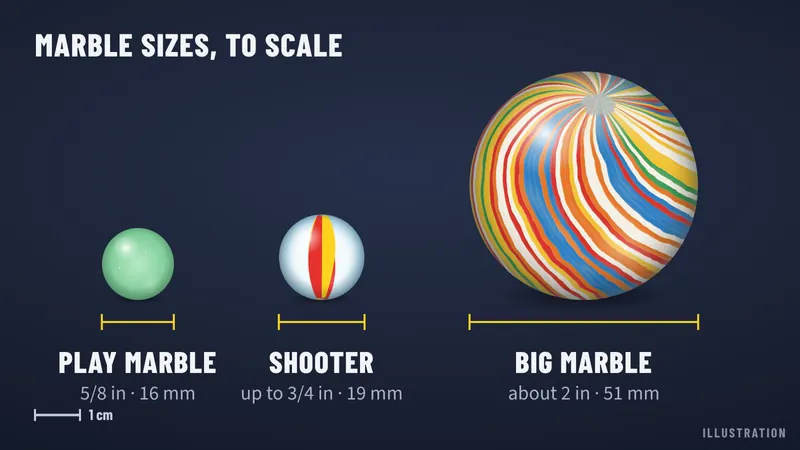
Marbles come in many sizes. Wikipedia gives a typical range of about 0.5 to 3.5 cm (0.2 to 1.4 inches) across [1].
- Standard play marbles are about 5/8 inch, or 16 mm. The US tournament uses 5/8 inch targets [11], and the Spielwarenmesse magazine gives 16 mm as the size for club play [10].
- Shooters are usually a bit bigger, up to about 3/4 inch for tournaments [11][12].
- Big marbles, like many modern art marbles, can be around 2 inches (5 cm) across. Wikipedia notes these are sometimes called "toe breakers" [1].
A note for new collectors
Marbles have been reproduced since at least the late 1970s [6], and some types are easy to confuse. If you think you have something old or rare, compare it with a collectors' society guide, or ask the Marble Collectors Society of America. We do not value or identify marbles.
Play it online
On Marble Spins, marbles race down tracks under real physics, and it is free to play in your browser. You can race in classic looks like clearies and cat's eyes, and looks never change who wins.
Sources
- Marble (toy) – Wikipedia — Short definitions of common types (aggie, clearie, cat's eye, china, clay, onionskin, Lutz, sulphide, steely, swirly, shooter); the Lutz naming myth; typical sizes
- Earthenware – Marble Collectors Society of America (marblecollecting.com) — Clay marbles, crockery and "Bennington" marbles
- Handmade Marbles – Marble Collectors Society of America (marblecollecting.com) — German handmade marbles and the pontil mark
- Lutz – Marble Collectors Society of America (marblecollecting.com) — Lutz bands of copper flakes or goldstone, and Lutz variants
- Go Figure: sulphide marbles – Maryland Archaeological Conservation Laboratory — What a sulphide is, where the name comes from, where and when they were made
- Marble FAQ – Marble Collectors Society of America (marblecollecting.com) — Clearies and opaques; cat's eyes after World War II; reproductions since the late 1970s
- Marble King – e-WV: The West Virginia Encyclopedia — Description of cat's eyes; first American-made cat's eyes credited to Roger Howdyshell
- Akro Agate Co. – Marble Collectors Society of America (marblecollecting.com) — Corkscrews, oxbloods and moonies as examples of machine-made types
- Marble (toy) – Britannica — Materials (clay, glass, steel, plastic, onyx, agate)
- Spheres of glass and stone – Spielwarenmesse magazine — Agate spheres from Idar-Oberstein; the 16 mm club marble size
- Tournament Rules – US National Marbles Tournament — Standard 5/8 inch target marbles and 1/2 to 3/4 inch shooters of glass or stone, never metal
- Rules – British and World Marbles Championship, Tinsley Green — The tolley, a shooter up to 3/4 inch
- Children's Games survey, item EE6a – Dictionary of American Regional English — Everyday names for the big shooting marble (shooter, steelie, boulder, aggie)